Showing posts with label Download. Show all posts

Friday, 16 October 2015

PIC Microcontroller (Architecture, Features, Programming, Datasheet, Projects)

PIC MICROCONTROLLER

PIC stands for peripheral interface controller

Where as F stands for Flash it represents the type of memory used,
In 2000, Microchip introduced the PIC18 architecture.Unlike the 17 series,with a large number of device variants presently in manufacture. In contrast to earlier devices, which were more often than not programmed in assembly, C has become the predominant development language.


PIC18F4520
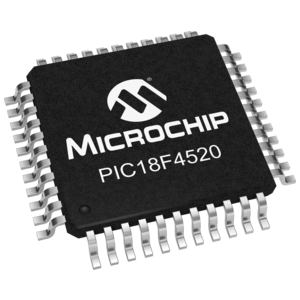
pic18f4520


Parameters of PIC18F4520 micro controller
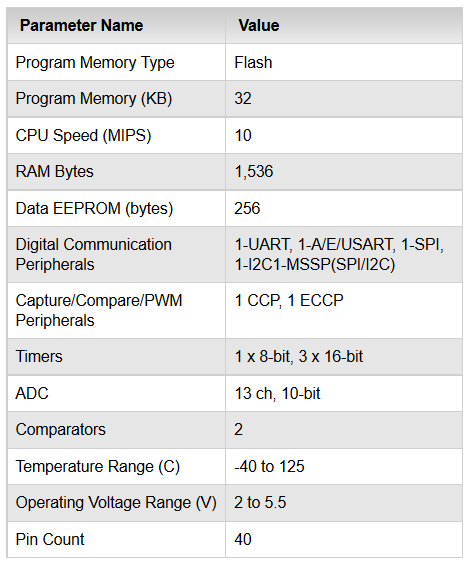
Features of PIC18f4520


Pin Diagram Of PIC18F4520

pin diagram of pic18f4520


The 18 series inherits most of the features and instructions of the 17 series, while adding a number of important new features:


PIC18 uses flash memory so that a data can be saved and erased number of times as per user requirement, not only this the battery used is used to give clock to the device.

Features of PIC micro controller

  CPU


        Up to 10 MIPS Performance at 3V
        C compiler optimized RISC architecture
        8x8 Single Cycle Hardware Multiply

  System

       
        Internal oscillator support-31 kHz to 8MHz with 4xPLL
        Fail-Safe Clock Monitor- allows safe shutdown if clock fails
        Watchdog Timer with separate RC oscillator
        Wide operating Voltage range; 2.0V to 5.5V

 nanoWatt Power Managed Modes


        Run, Idle and SLEEP modes
        Idle mode currents down to 5.8uA typical
        Sleep mode currents down to 0.1uA typical 
   

 Analog Features


        10-bit ADC, 13 channels, 100K samples per second
        Programmable Low Voltage Detection Module
        Programmable Brown-out-Reset Module
        Two Analog Comparators multiplexing 

  Peripherals

        Master Synchronous Serial Port supports SPI™ and I2C™ master and slave mode
        EUSART module including LIN bus support
        Four Timer modules
        Up to 5 PWM outputs
        Up to 2 Capture / Compare 


Advantages


  1. Small instruction set to learn and implement
  2. PIC has RISC architecture
  3. Built-in oscillator with selectable speeds
  4. Easy entry level, in-circuit programming plus in-circuit debugging PICkit units available for less than $50
  5. Inexpensive microcontrollers
  6. Wide range of interfaces including I²C, SPI, USB, USART, A/D, programmable comparators, PWM, LIN, CAN, PSP, and Ethernet
  7. Availability of processors in DIL package make them easy to handle for hobby use.


Comparison between PIC and 8051


8051- if u want a cheap controller with basic functions then 8051 will suffice . It will be of great use in your low cost college projects.

PIC- Cheap , used in refrigerators and low budget projects .

8051 and PIC need multiple clock cycles per instruction. AVR and ARM execute most instructions in a single clock cycle.

8051 and PIC have limited stack space - limited to 128 bytes for the 8051, and as little as 8 words or less for PIC. Writing a C compiler for these architectures must have been challenging, and compiler choice is limited.


Real Time Applications and Projects of PIC

1) PIC can be used to design Data Acquisition System

2)Digital clock can be implemented using PIC

3)Frequency counter are another application

4)PIC can be used as Timers, counters

5)We can design a calculator using PIC


Download Datasheet of PIC18F4520

Check out how to use PIC microcontroller using PICKit 3 or Proteus.

You can also learn how to configure DSP Processor.


Check out Complete Interview Guide For BE

Thursday, 17 September 2015

What is Deadlock? Defination of Deadlock in Operating System Pdf/ebook/ppt Download Free

What is Deadlock?


  • System Model
  • Deadlock Characterization
  • Methods for Handling Deadlocks
  • Deadlock Prevention
  • Deadlock Avoidance
  • Deadlock Detection
  • Recovery from Deadlock
  • Combined Approach to Deadlock Handling
A set of blocked processes each holding a resource and waiting to acquire a resource held by another process in the set.
Example
System has 2 tape drives.
P1 and P2 each hold one tape drive and each needs another one.
Example
semaphores A and B, initialized to 1

    P0           P1
wait (A);        wait(B)
wait (B);        wait(A)


Meaning of Deadlock

A set of blocked processes each holding a resource and waiting to acquire a resource held by another process in the set.
dead lock

 Example
A system having 2 tape drives or cd drives.

Here is a ppt which contains everything related to Deadlock, images, examples, problems,

you can view the ppt directly without downloading it,

  
 Bridge Crossing Example

  • Traffic only in one direction.
  • Each section of a bridge can be viewed as a resource.
  • If a deadlock occurs, it can be resolved if one car backs up (preempt resources and rollback).
  • Several cars may have to be backed up if a deadlock occurs.
  • Starvation is possible.
Resource types R1, R2, . . ., Rm
CPU cycles, memory space, I/O devices
Each resource type Ri has Wi instances.
Each process utilizes a resource as follows:

  • request
  • use
  • release
Deadlock Characterization
Deadlock can arise if four conditions hold simultaneously.

Mutual exclusion:  only one process at a time can use a resource.
 

Hold and wait:  a process holding at least one resource is waiting to acquire additional resources held by other processes.
 

No preemption:  a resource can be released only voluntarily by the process holding it, after that process has completed its task.
 

Circular wait:  there exists a set {P0, P1, …, P0} of waiting processes such that 

P0 is waiting for a resource that is held by P1,
    P1 is waiting for a resource that is held by  P2, …,
    Pn–1 is waiting for a resource that is held by Pn,
    and P0 is waiting for a resource that is held by P0.

Resource-Allocation Graph
A set of vertices V and a set of edges E.


V is partitioned into two types:
P = {P1, P2, …, Pn}, the set consisting of all the processes in the system.
R = {R1, R2, …, Rm}, the set consisting of all resource types in the system.
request edge – directed edge P1 -> Rj
assignment edge – directed edge Rj ->  Pi


Basic Facts 
If graph contains no cycles -> no deadlock.
If graph contains a cycle
if only one instance per resource type, then deadlock.
if several instances per resource type, possibility of deadlock


Methods for Handling Deadlocks
  1. Ensure that the system will never enter a deadlock state.
  2. Allow the system to enter a deadlock state and then recover.
  3. Ignore the problem and pretend that deadlocks never occur in the system; used by most operating systems, including UNIX.
 Also read 10 awesome tips for viva and practicals
 Deadlock Prevention


Mutual Exclusion – not required for sharable resources; must hold for nonsharable resources.
 

Hold and Wait – must guarantee that whenever a process requests a resource, it does not hold any other resources.
 

Require process to request and be allocated all its resources before it begins execution, or allow process to request resources only when the process has none.
Low resource utilization; starvation possible.


No Preemption – If a process that is holding some resources requests another resource that cannot be immediately allocated to it, then all resources currently being held are released.
 

Preempted resources are added to the list of resources for which the process is waiting.
 

Process will be restarted only when it can regain its old resources, as well as the new ones that it is requesting.
 

Circular Wait – impose a total ordering of all resource types, and require that each process requests resources in an increasing order of enumeration

Deadlock Avoidance

Simplest and most useful model requires that each process declare the maximum number of resources of each type that it may need.
 

The deadlock-avoidance algorithm dynamically examines the resource-allocation state to ensure that there can never be a circular-wait condition.
 

Resource-allocation state is defined by the number of available and allocated resources, and the maximum demands of the processes.


Safe State

When a process requests an available resource, system must decide if immediate allocation leaves the system in a safe state.
System is in safe state if there exists a safe sequence of all processes.
Sequence <P1, P2, …, Pn> is safe if for each Pi, the resources that Pi can still request can be satisfied by currently available resources + resources held by all the Pj, with j<I.
If Pi resource needs are not immediately available, then Pi can wait until all Pj have finished.
When Pj is finished, Pi can obtain needed resources, execute, return allocated resources, and terminate.
When Pi terminates, Pi+1 can obtain its needed resources, and so on.


Basic Facts

If a system is in safe state  no deadlocks.
If a system is in unsafe state  possibility of deadlock.
Avoidance  ensure that a system will never enter an unsafe state.


safe unsafe deadlock 

 Resource-Allocation Graph Algorithm

Claim edge Pi => Rj indicated that process Pi may request resource Rj; represented by a dashed line.
 

Claim edge converts to request edge when a process requests a resource.
When a resource is released by a process, assignment edge reconverts to a claim edge.
Resources must be claimed a priori in the system.


Resource-Allocation Graph For Deadlock Avoidance


Resource-Allocation Graph For Deadlock Avoidance

Unsafe State In Resource-Allocation Graph


Deadlock Condition System Programming & Operating system pdf


If you are facing any problems viewing the document please comment below


Here are some other programs of DSP Matlab

Discrete fourier transform
Modulo operator 
Linear Convolution   
 
Entc Engg. Powered by Blogger.